The Direct-Injection Guide to Restoring Lost Throttle Response (2026)
A practical guide to cleaning clogged gasoline direct-injection injectors in GDI, TSI, TFSI, EcoBoost, JTS, CGI, and similar modern petrol engines.
Quick Summary
What to know first
If a direct-injection petrol engine hesitates under load, shakes at idle, or stumbles on cold starts, injector-tip coking may be distorting its spray pattern. This guide explains how to identify GDI and choose an appropriate curative treatment.

This guide is specifically for gasoline direct-injection engines: GDI, TSI, TFSI, JTS, CGI, EcoBoost, and comparable systems that place the injector nozzle inside the combustion chamber. A separate guide will cover traditional port-injection systems, which face a different deposit pattern and do not need the same product shortlist.
If a direct-injection petrol car feels flat during acceleration, stumbles on cold starts, or idles unevenly, restricted atomization at the injector tip may be part of the problem. These nozzles operate at high pressure in a severe thermal environment, so deposits can distort their microscopic spray openings.
The response should be deliberate: use a curative cleaner suited to direct-injection deposits, follow its label dosage, complete a proper warm drive, and then reassess. Do not keep pouring bottles into a car whose fault is actually an ignition coil, pressure sensor, vacuum leak, or damaged injector.
Fast Picks
Fastest curative option for active hesitation -> BG 44K Platinum
Best widely available intensive cleaner -> Wynn’s Extreme Petrol Clean
Best Liqui Moly curative option for rough running -> Liqui Moly 5129 / DIJectron
Best post-clean maintenance formula -> Liqui Moly Injection Reiniger
Technical Note: Polyetheramine (PEA)
Polyetheramine is a high-temperature detergent used in specialized fuel-system cleaners to isolate and remove persistent injector and combustion chamber deposits. Because retail product labels rarely disclose active detergent concentrations, do not assume every formulation marketed for GDI systems contains the same underlying chemistry or cleaning strength.
Does your engine use direct injection? Verify your engine group
The Modern Shift: Does Your Car Use Direct Injection?
If your petrol car was built within the last 15 years, there is a good chance it uses Gasoline Direct Injection (GDI)A high-pressure fuel system that sprays petrol directly into each combustion chamber rather than into the intake port.A high-pressure fuel system that sprays petrol directly into each combustion chamber rather than into the intake port.. It is not guaranteed, however: some newer cars still use port injection, while others combine both systems. Confirm the engine specification in the owner’s manual, manufacturer data, or a VIN-based parts catalogue before buying a cleaner.
Direct injection improves fuel control by moving each injector from the intake port into the combustion chamber. Modern systems commonly operate at well over 100 bar, with some exceeding 200 bar, to deliver a precisely timed fuel mist directly into the cylinder.
Does Your Engine Use Direct Injection?
Before applying a curative treatment, verify your engine family below. If your system is not listed here, it may use traditional port injection or a combined dual-injection layout requiring a different maintenance path. The badge on the engine cover is a clue, not final proof; confirm the exact engine code where noted.
| Automotive Group | Common Engine Label | Injection System Type |
|---|---|---|
| Volkswagen / Audi / SEAT / Skoda | TSI / TFSI / FSI | Direct injection; some later EA888 engines use dual injection |
| Mercedes-Benz | CGI / BlueDIRECT | Direct injection |
| BMW / MINI | TwinPower Turbo | Commonly direct injection; check the exact engine code to confirm |
| General Motors / Chevrolet | SIDI / Ecotec DI | Spark-ignition direct-injection applications; Ecotec alone does not confirm the system |
| Ford / Lincoln | EcoBoost | Commonly direct injection; some later applications use dual injection |
| Mazda | Skyactiv-G / Skyactiv-X | Direct-injection applications; verify the exact engine and market specification |
| Toyota / Lexus | D-4S / D-4ST / FSE | Dual or direct injection depending on the engine; D-4S combines port and direct injectors |
| Honda / Acura | Earth Dreams VTEC | Many applications use direct injection, but the family label also covers other layouts |
| Alfa Romeo | JTS / TBi | Direct-injection applications; confirm the exact engine variant |
| Hyundai and Kia | GDI / T-GDI | Gasoline direct injection |
| Peugeot / Citroen / Opel / DS | PureTech | Direct-injection applications; verify the engine generation |
- Common Engine Label
- TSI / TFSI / FSI
- Injection System Type
- Direct injection; some later EA888 engines use dual injection
- Common Engine Label
- CGI / BlueDIRECT
- Injection System Type
- Direct injection
- Common Engine Label
- TwinPower Turbo
- Injection System Type
- Commonly direct injection; check the exact engine code to confirm
- Common Engine Label
- SIDI / Ecotec DI
- Injection System Type
- Spark-ignition direct-injection applications; Ecotec alone does not confirm the system
- Common Engine Label
- EcoBoost
- Injection System Type
- Commonly direct injection; some later applications use dual injection
- Common Engine Label
- Skyactiv-G / Skyactiv-X
- Injection System Type
- Direct-injection applications; verify the exact engine and market specification
- Common Engine Label
- D-4S / D-4ST / FSE
- Injection System Type
- Dual or direct injection depending on the engine; D-4S combines port and direct injectors
- Common Engine Label
- Earth Dreams VTEC
- Injection System Type
- Many applications use direct injection, but the family label also covers other layouts
- Common Engine Label
- JTS / TBi
- Injection System Type
- Direct-injection applications; confirm the exact engine variant
- Common Engine Label
- GDI / T-GDI
- Injection System Type
- Gasoline direct injection
- Common Engine Label
- PureTech
- Injection System Type
- Direct-injection applications; verify the engine generation
Why this changes the cleaning strategy: A GDI injector tip sits in the combustion chamber and is exposed to repeated pressure and heat cycles. Residual fuel can bake onto the nozzle face after shutdown and disturb its spray pattern. Strong detergent packages, often built around PEA chemistryPolyetheramine: A high-temperature detergent used in some fuel-system cleaners to help remove persistent injector and combustion deposits.Polyetheramine: A high-temperature detergent used in some fuel-system cleaners to help remove persistent injector and combustion deposits., are more appropriate for curative cleaning than generic light-maintenance fluids. In-tank cleaner still cannot wash the backs of GDI intake valves because fuel never passes over them.
The Mechanics of Injector Coking
In a port-injection engine, the injector sprays upstream into the intake port. A direct-injection engine moves that injector into the cylinder, where its nozzle face sees combustion pressure, heat, and repeated hot shutdowns. Residual fuel can oxidize and bake onto the tip, gradually narrowing or distorting the spray holes.
| Injection Design | Injector Location | What In-Tank Cleaner Can Reach |
|---|---|---|
| Port injection (PFI) | In the intake port, upstream of the valve | Injector internals, nozzle, and fuel-wetted intake path |
| Direct injection (GDI) | Inside the combustion chamber | Injector internals and nozzle face, but not the backs of the intake valves |
| Dual injection | Port and direct injectors | Both fuel circuits may be treated, but operation depends on the engine strategy |
- Injector Location
- In the intake port, upstream of the valve
- What In-Tank Cleaner Can Reach
- Injector internals, nozzle, and fuel-wetted intake path
- Injector Location
- Inside the combustion chamber
- What In-Tank Cleaner Can Reach
- Injector internals and nozzle face, but not the backs of the intake valves
- Injector Location
- Port and direct injectors
- What In-Tank Cleaner Can Reach
- Both fuel circuits may be treated, but operation depends on the engine strategy
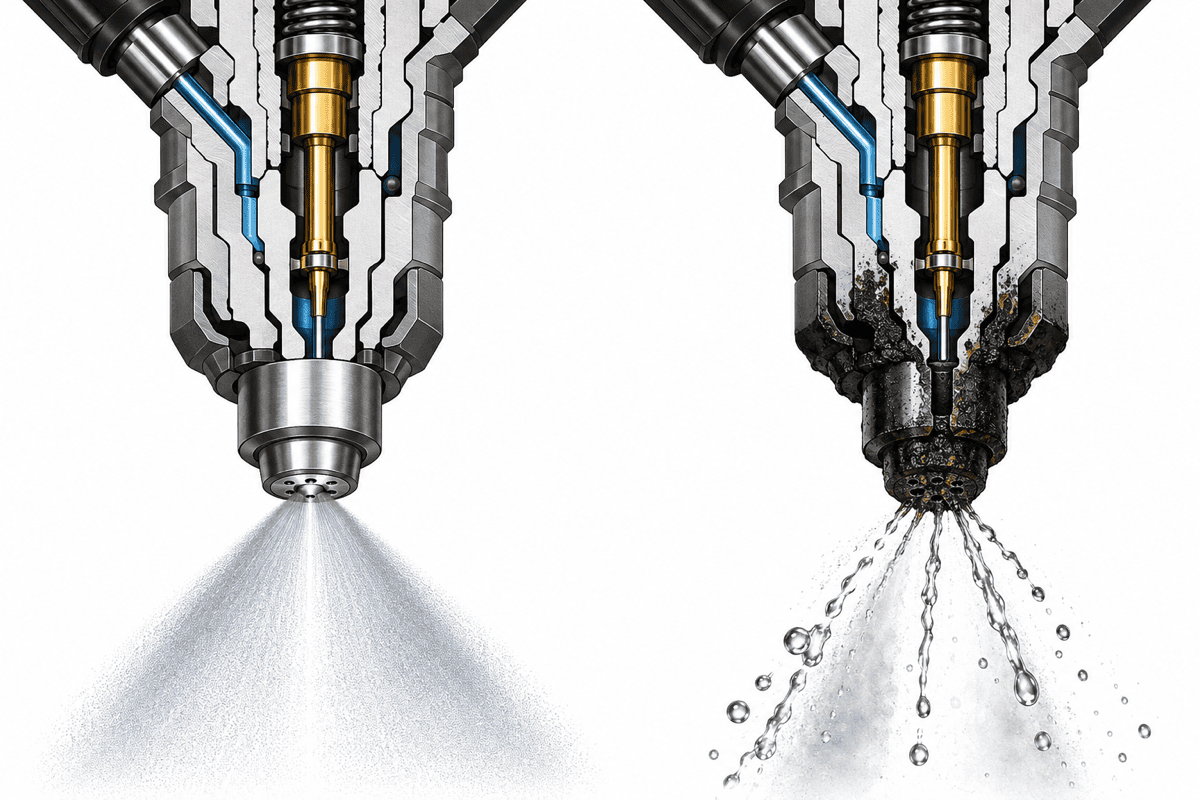
| System Symptom | Normal Operation | Injector Coking (Failure) |
|---|---|---|
| Throttle response | Crisp, responsive | Flat, delayed |
| Idle behavior | Smooth, stable | Rough, shaky |
| Cold starts | Instant, clean | Stumble, rough |
| Fuel spray pattern | Fine atomized mist | Uneven droplets |
| Exhaust character | Clean, neutral | Sooty, harsh |
| Injector tip condition | Clear nozzle face | Carbon-baked tip |
- Normal Operation
- Crisp, responsive
- Injector Coking (Failure)
- Flat, delayed
- Normal Operation
- Smooth, stable
- Injector Coking (Failure)
- Rough, shaky
- Normal Operation
- Instant, clean
- Injector Coking (Failure)
- Stumble, rough
- Normal Operation
- Fine atomized mist
- Injector Coking (Failure)
- Uneven droplets
- Normal Operation
- Clean, neutral
- Injector Coking (Failure)
- Sooty, harsh
- Normal Operation
- Clear nozzle face
- Injector Coking (Failure)
- Carbon-baked tip
Over time, microscopic spray holes can partially clog. Fuel then exits as a poor stream instead of a fine mist. Combustion quality drops, response gets inconsistent, and hesitation shows up when torque demand rises.
That is why many drivers feel a clear difference on ramps, overtakes, and loaded uphill pulls before they notice anything at idle.
What Is PEA Chemistry (And Why It Matters)
PEA chemistryPolyetheramine: A high-temperature detergent used in some fuel-system cleaners to help remove persistent injector and combustion deposits.Polyetheramine: A high-temperature detergent used in some fuel-system cleaners to help remove persistent injector and combustion deposits. is one of the most relevant detergent types for direct-injection troubleshooting. For a driver, the practical point is simple: a curative formula needs enough deposit-control strength to work through a complete hot operating cycle.
Light maintenance fluids can be useful for keeping an already healthy fuel system tidy, but that is not the job this article addresses. Here the target is persistent material on and around a direct injector’s nozzle openings, where poor spray quality can become most obvious under load.
That is why a stronger curative detergent package is the more relevant first chemical step for acceleration hesitation, rough loaded pull, and unstable combustion behavior when diagnosis points toward direct-injector deposits. Improvement supports that diagnosis; no improvement means it is time to test ignition, air metering, fuel pressure, and mechanical condition.
Signs Your Direct Injectors May Be Clogged
- Flat or delayed response when you press the throttle
- Rough idle that comes and goes, especially after short-trip driving
- Cold-start stumble or unstable first-minute running
- Higher fuel consumption with no obvious leak
- Sootier tailpipe or harsher exhaust smell
Who This Guide Is For / Not For
Who it is for:
- Owners of GDI, TSI, TFSI, CGI, JTS, EcoBoost, Skyactiv-G, and other direct-injection petrol engines with hesitation or inconsistent pull
- High-mileage commuters with short-trip driving patterns
- Drivers preparing for emissions checks and smoother combustion
Not for:
- Dead injector solenoids, cracked injectors, or broken wiring
- Severe intake-valve coking that needs walnut blasting
- Misfires caused by worn plugs, failed coils, or compression loss
- Port-injection engines; those will be covered separately with a different product shortlist
The 4 Best Direct-Injection Petrol Treatments and Maintenance Products
Summary of the Best GDI Treatments and Maintenance Products
| Product | Core Chemistry | Primary Target | Best Use Case |
|---|---|---|---|
| BG 44K PlatinumBest Curative | Professional detergent and solvent shock package | GDI, TSI, TFSI, EcoBoost and CGI | Active acceleration hesitation and heavy flat spots |
| Wynn's Extreme Petrol Clean | Concentrated high-temperature detergent package | Modern direct injection in European and US markets | Periodic deposit control for stop-and-go city cars |
| Liqui Moly 5129 / DIJectronBest GDI Shock Treatment | Curative gasoline-system detergent blend | TSI, TFSI, CGI, EcoBoost and similar systems | Erratic cold starts and rough, shaking idle |
| Liqui Moly Injection ReinigerBest Maintenance | Maintenance detergent and corrosion protection | Healthy GDI and dual-injection fuel systems | Post-clean deposit prevention and routine upkeep |
- Core Chemistry
- Professional detergent and solvent shock package
- Primary Target
- GDI, TSI, TFSI, EcoBoost and CGI
- Best Use Case
- Active acceleration hesitation and heavy flat spots
- Core Chemistry
- Concentrated high-temperature detergent package
- Primary Target
- Modern direct injection in European and US markets
- Best Use Case
- Periodic deposit control for stop-and-go city cars
- Core Chemistry
- Curative gasoline-system detergent blend
- Primary Target
- TSI, TFSI, CGI, EcoBoost and similar systems
- Best Use Case
- Erratic cold starts and rough, shaking idle
- Core Chemistry
- Maintenance detergent and corrosion protection
- Primary Target
- Healthy GDI and dual-injection fuel systems
- Best Use Case
- Post-clean deposit prevention and routine upkeep
BG 44K Platinum - Best for Severe Acceleration Hesitation
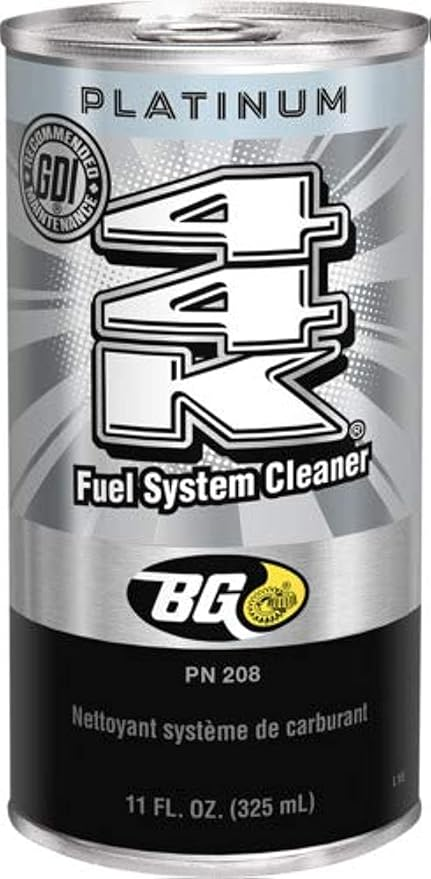
BG 44K Platinum
This is the curative-first pick when the car is already struggling under throttle.
BG 44K is known for high cleaning intensity and is commonly used as a one-tank rescue before deeper diagnostics. On engines showing active hesitation, it is one of the few off-the-shelf options that can materially change drive feel in a short cycle.
Mechanically, the goal is to restore a cleaner spray pattern at the injector face so each cylinder gets a more stable fuel mist under load. When atomization improves, ignition delay drops, torque delivery becomes more predictable, and those dead spots during throttle transitions usually reduce.
The fuel-system benefit is not just “cleaner injectors” in abstract terms. It is a chain reaction: cleaner nozzle orifices improve droplet size distribution, better droplets improve burn consistency, and more consistent burn reduces cycle-to-cycle torque variation that drivers feel as flat spots.
In cars with adaptive fueling, this can also calm short-term correction swings after a few proper heat cycles, especially when the hesitation was fuel-side and not ignition-side. That is why BG 44K is a useful mechanical diagnostic step before expensive injector replacement.
This is why drivers often report improvement first in highway merges and uphill pulls, not in calm cruising. Under high load, poor fuel atomization hurts most. A stronger curative cleaner can bring back smoother pull by reducing deposit-driven spray distortion before you assume injector hardware is dead.

Technical Efficacy
- High-Intensity Detergent PackageDesigned as a curative fuel-system treatment for persistent deposits rather than light routine upkeep.
- Spray-Pattern Restoration ObjectiveTargets deposit-related nozzle restriction that can disturb atomization during throttle transitions and loaded running.
- Useful Diagnostic BaselineA repeatable improvement after correct treatment supports a fuel-side deposit diagnosis before injector replacement.

Operating Realities
 Premium Treatment CostCarries a higher cost per treated tank than basic stabilizers and maintenance additives.
- Periodic Use OnlyFollow the current label interval and dosage instead of repeating shock treatments through sequential tanks.
- Zero Mechanical Repair CapabilityCannot repair open injector circuits, damaged solenoids, failed pumps, or structural compression loss.
Watch out:
- Use it as a periodic curative pass, not an every-fill ritual.
- If there is no change after a correct treatment cycle, move to ignition, pressure, and sensor diagnostics quickly.
- A cleaner cannot repair cracked injector bodies, electrical faults, or mechanical compression loss.
Compliance & Safety Check (Expand to View)
- Chemical profile & safety: Professional detergent and solvent blend. Consult the current regional safety data sheet before handling because classifications can vary by market and revision.
- Risk warnings:
H304Aspiration hazard: may be fatal if swallowed and enters airways.H315Causes skin irritation.H319Causes serious eye irritation. - Note: Professional-grade strength. Built for rapid deposit dissolution and best used with proper ventilation during refueling application.
- First aid / handling: If swallowed, do not induce vomiting due to aspiration risk. Seek medical attention immediately. Wear nitrile gloves during application.
- Manufacturer / registry: BG Products, Inc., Wichita, KS, USA.
- EU responsible person (GPSR): Compliance is typically managed via BG Products UK and other authorized regional EU distributors.
- Traceability profile: High. Documentation and distribution are tightly controlled through authorized specialist channels.
Wynn’s Extreme Petrol Clean - Best Widely Available Intensive Cleaner
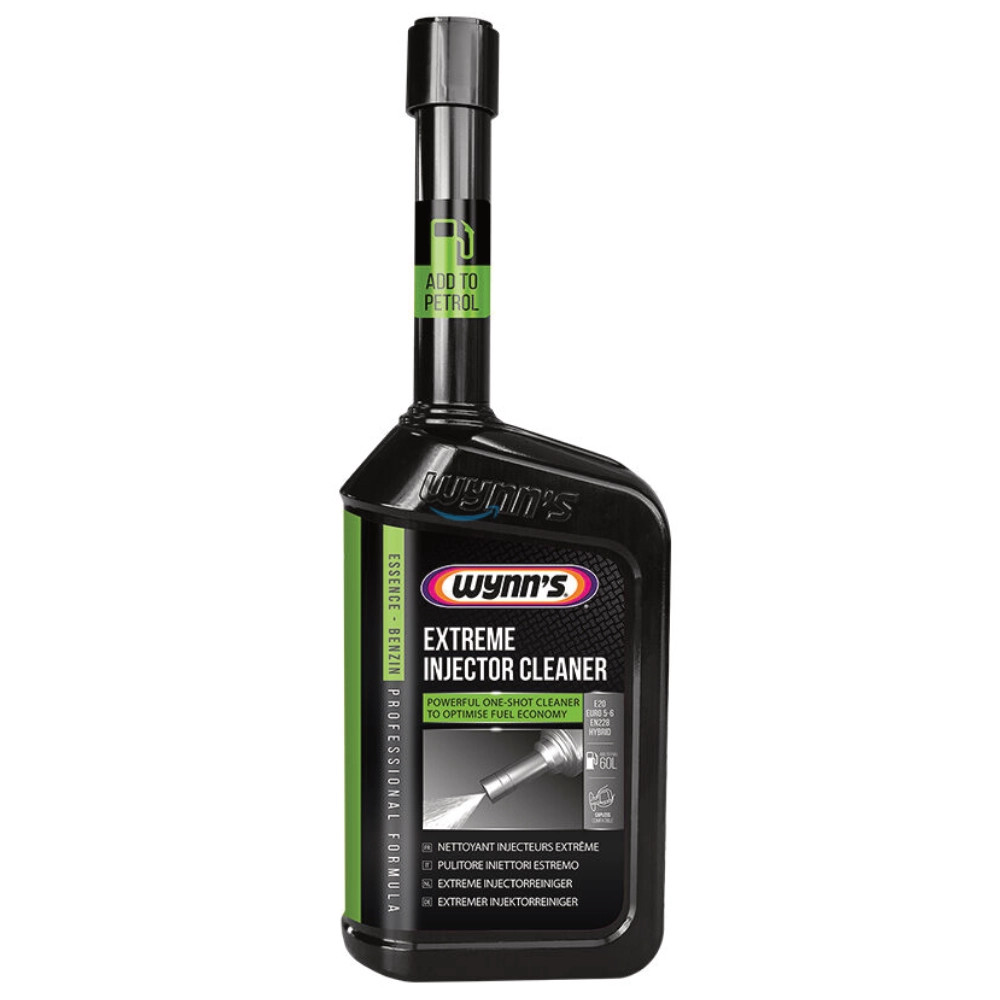
Wynn’s Extreme Petrol Clean
If you want an intensive treatment with broad European marketplace availability, this is the practical pick.
Wynn’s Extreme Petrol Clean is designed around high-temperature deposit control for modern direct-injection combustion stress. It is especially useful when drivability is inconsistent but you do not want to jump straight into mechanical injector service.
Its curative value comes from a stronger detergent brief than a routine keep-clean additive. It targets residue around nozzle tips where direct-injection engines see repeated thermal cycling. Cleaner nozzle geometry means better atomization and fewer localized lean or delayed-burn moments.
In practice, this often helps engines that feel erratic in stop-go use, short trips, and low-rpm punch-out events. It is not a miracle bottle, but it is a legitimate pre-workshop diagnostic step when symptoms point to fuel-side deposit loading.
Wynn’s also makes sense when you want a stronger clean without jumping into invasive procedures. It works as a controlled chemical intervention: treat, heat-cycle, and evaluate. If response sharpens and stumbles reduce, you likely confirmed a deposit-driven fueling problem.
Technical Efficacy
- Targeted GDI DetergencyWynn’s explicitly lists direct-injection petrol systems among its supported applications.
- Strong European AvailabilityCommonly available through Spanish, German, and broader continental distribution channels.
- Curative Middle GroundBridges the gap between light upkeep fluids and invasive rail removal or injector service.
Operating Realities
- Unnecessary for Symptom-Free EnginesA healthy low-mileage engine may only need label-approved maintenance rather than an intensive reset.
- Needs a Complete Treatment CycleA fully warmed drive and normal use through the treated tank are more useful than brief idling or repeated short trips.
- Clear Diagnostic LimitsCannot stabilize idle or hesitation caused by vacuum leaks, airflow faults, ignition failures, or low compression.
Watch out:
- Treat this as a periodic reset formula, not a daily maintenance additive.
- Give it a proper warm-drive cycle after dosing; city idling alone limits results.
- If misfires continue with no fuel-trim improvement, start hard diagnostics instead of repeating bottles.
Compliance & Safety Check (Expand to View)
- Chemical profile & safety: Concentrated detergent system. Follow the current regional CLP label and safety data sheet rather than relying on marketplace copy.
- Risk warnings:
H304Aspiration hazard: may be fatal if swallowed and enters airways.H411Toxic to aquatic life with long-lasting effects. - Note: Designed for modern high-pressure direct-injection systems and includes lubricity support to offset solvent stress.
- First aid / handling: Follow hydrocarbon safety protocols. Tighten the filler cap securely after dosing to limit vapor release.
- Manufacturer / registry: Wynn’s (ITW Global Brands), Sint-Niklaas, Belgium.
- EU responsible person (GPSR): ITW Additives International, Belgium, via Wynn’s regional EU compliance channels.
- Traceability profile: Excellent. EU-manufactured and batch coded with strong regional ECHA/CLP traceability.
Liqui Moly Motorsystemreiniger Benzin / DIJectron - Best Curative GDI Shock Treatment
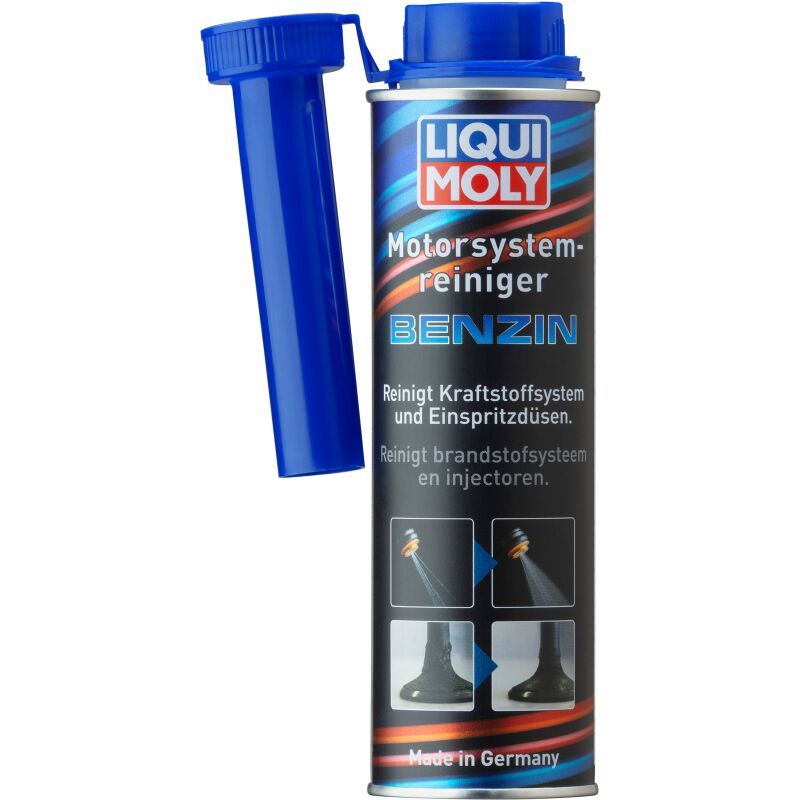
Liqui Moly Motorsystemreiniger Benzin / DIJectron
This is the high-strength curative formula for modern direct-injection engines (GDI, TSI, TFSI, EcoBoost) when the car already feels flat, rough, or unstable.
It uses a curative detergent package intended to remove fuel-system deposits and restore mixture formation when lighter maintenance formulas are no longer enough. Liqui Moly positions the 5129 formula as a problem-solving gasoline system cleaner, rather than merely a keep-clean additive.
Mechanically, this is the curative rail-and-nozzle reset option for engines that feel rough despite normal service. As deposits harden on injector outlets, atomization degrades and flame-front consistency suffers. That is where drivers feel unstable idle, delayed pickup, and flat response when stepping into throttle.
By targeting high-heat fuel-side deposits, this formulation helps restore more even cylinder fueling behavior. It does not replace spark, compression, or sensor diagnostics, but it is the right chemical intervention when symptom pattern strongly points to injector-tip coking.
This is also where the Liqui Moly naming confusion causes expensive mistakes. Buyers often see “Injection Reiniger” or “Jectron” and assume all variants are equal. They are not. Motorsystemreiniger Benzin / DIJectron is the curative formula for tougher coking behavior, while the lighter products are maintenance-focused.
Technical Efficacy
- Curative System RestorerA concentrated problem-solving detergent blend aimed at fuel-side lacquer and uneven mixture formation.
- Modern High-Pressure RelevanceBetter aligned with direct-injection deposit behavior than Liqui Moly’s lighter maintenance formula.
- Pre-Workshop ValidationA sensible chemical step before committing to injector removal or replacement when deposits remain plausible.
Operating Realities
- Strict Label-Led DosingUse it at the product’s documented interval and concentration, not through sequential tank fill-ups.
- Catalog Listing TrapBrand-name overlap makes exact formula and part-number verification essential before purchase.
- No Structural CorrectionWill not address misfires rooted in plugs, coils, wiring, compression loss, or dry-side intake-valve carbon.
🌍 Cross-Border Sourcing Guide
- Spain & Germany: Liqui Moly Motorsystemreiniger Benzin (Art.-Nr. 5129)
- United States: Liqui Moly DIJectron (Art.-Nr. 22076)
Where to buy: use listings that clearly show the exact formula name and part number for your region.
Critical warning: do not confuse this with standard Injection Reiniger or lighter Jectron maintenance bottles if you are trying to clear severe GDI coking and acceleration stumbles.
Watch out:
- Do not buy by brand name alone; buy by exact formula name and part number.
- This is a curative shock treatment, so periodic use is correct and overuse is not.
- If no drivability change appears after proper use, stop chemical guessing and diagnose ignition/air/fuel pressure properly.
Compliance & Safety Check (Expand to View)
- Chemical profile & safety: Curative gasoline fuel-system detergent blend. Use the current Liqui Moly regional safety data sheet for exact composition and CLP handling information.
- Risk warnings:
H304Aspiration hazard: may be fatal if swallowed and enters airways.H411Toxic to aquatic life with long-lasting effects. - Note: Tuned for thermal stress in GDI systems so deposits are dissolved instead of migrating and re-baking in downstream components.
- First aid / handling: Do not reuse empty containers. Seek medical advice if respiratory irritation occurs from vapor exposure.
- Manufacturer / registry: LIQUI MOLY GmbH, Ulm, Germany.
- EU responsible person (GPSR): Managed directly by LIQUI MOLY GmbH under EU REACH/CLP documentation channels.
- Traceability profile: Elite. Part of Liqui Moly’s direct-injection-specific line with full EU emissions-platform documentation.
Liqui Moly Injection Reiniger - Best for Post-Clean Maintenance
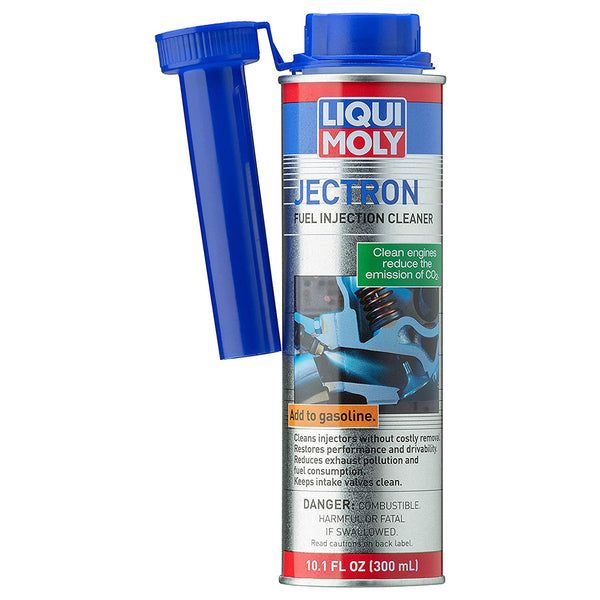
Liqui Moly Injection Reiniger / Injection Cleaner
This is the maintenance product in the shortlist, not the bottle to choose for an injector that is already suffering from severe hard coking. Its job begins after a stronger curative treatment has restored acceptable running: keep the fuel-wetted system cleaner, reduce the chance of fresh deposits taking hold, and provide routine corrosion protection.
Liqui Moly describes Injection Reiniger as a gasoline-system treatment that removes deposits from injection components, helps prevent new deposits, and maintains the injection system. That makes it a sensible follow-up for a GDI engine that is now running correctly but spends much of its life on short journeys, repeated hot shutdowns, or inconsistent fuel quality.
For a direct-injection engine, the treated petrol can reach the fuel circuit, injector internals, and nozzle face. It still cannot wash the dry backs of the intake valves, and it should not be presented as an intake-valve carbon treatment. On a dual-injection engine, treated fuel may pass through both the port and direct circuits when the engine control strategy operates them, although that behavior varies by engine and driving condition.
This distinction matters because retail listings often blur together Injection Reiniger, Injection Cleaner, Jectron, DIJectron, and the dedicated Pro-Line Direct Injection Cleaner. Standard Injection Reiniger is the lighter keep-clean and maintenance choice. Liqui Moly 5129 / DIJectron and other intensive products in this guide are the better choices when active hesitation suggests that a curative cycle is justified.
Technical Efficacy
- Post-Clean PreservationHelps prevent fresh deposits from rebuilding after a successful high-strength curative treatment.
- Fuel-System CareLiqui Moly documents deposit control, corrosion protection, and maintenance of gasoline injection components.
- Reliable Regional LogisticsWidely distributed with identifiable 2522 and 5110 regional packaging variants.
Operating Realities
- Lacks Severe Curative DepthNot intended to dissolve stubborn hard coking or resolve an active throttle flat spot by itself.
- No External Valve AccessTreated petrol never washes over the dry backs of direct-injection intake valves.
- Retail Digital ConfusionFrequently grouped with Pro-Line cleaners and stronger system restorers on multi-seller storefronts.
Cross-Border Sourcing Guide
- Spain and Iberian packaging: Liqui Moly Injection Reiniger (Art.-Nr. 2522, DE-ES-PT label set)
- Other European and international packaging: Liqui Moly Injection Cleaner (Art.-Nr. 5110, regional label set)
Liqui Moly lists both article numbers within the same official Injection Cleaner product family. Packaging language and marketplace title can differ, so match the product name and article number rather than relying on a seller’s translated title alone.
Watch out:
- Use the current label dosage. Liqui Moly states that one 300 ml can treats up to 70 liters of petrol.
- The manufacturer states an effect lasting up to 2,000 km; it does not prescribe a universal every-three-or-four-fill-ups schedule.
- Do not confuse this maintenance formula with Pro-Line Direct Injection Cleaner or Liqui Moly 5129 / DIJectron when you need an intensive curative treatment.
- Do not treat it as a repair for a failed high-pressure pump, damaged injector, ignition fault, or mechanical compression problem.
Compliance & Safety Check (Expand to View)
- Chemical profile & safety: Gasoline fuel-system detergent and corrosion-protection additive. Consult the current regional label and Liqui Moly safety data sheet for the exact market-specific classification.
- Risk warnings:
H304May be fatal if swallowed and enters airways. - First aid / handling: If swallowed, do not induce vomiting. Contact a poison center or physician immediately. Keep the container closed and away from heat and ignition sources.
- Manufacturer / registry: LIQUI MOLY GmbH, Jerg-Wieland-Str. 4, 89081 Ulm, Germany. Regional article numbers include 2522 and 5110.
- EU responsible person (GPSR): Managed directly by LIQUI MOLY GmbH through its EU product and chemical-compliance documentation.
- Traceability profile: Strong. The official product family publishes regional article numbers, application guidance, and downloadable safety documentation.
Technical Application Guide
Calculate the Fuel Volume Ratio
Prerequisite
Check the product label and your owner's manual, then match the stated dose to the amount of petrol you will add. An overly dense additive mix is not a better GDI treatment and can introduce avoidable drivability or emissions issues.
Add the Cleaner Before Refueling
At the Fuel Station
When the product instructions permit it, run the tank down to the recommended level and pour the label-specified curative dose directly into the fuel neck before adding petrol. The incoming petrol helps mix the additive through the tank. Do not pour an entire bottle into a small fuel volume unless its label explicitly specifies that concentration, and never improvise a direct fuel-line flush with an in-tank product.
Complete a Sustained Heat Cycle
30-40 Minutes
A 30-40 minute drive is more useful than stationary idling or repeated short trips because it provides steady treated-fuel flow through the injectors. Use normal varied load and legal road speeds; the goal is sustained operating temperature and repeated injector operation, not aggressive redlining.
Run Down the Tank and Re-evaluate
Final Step
Monitor the engine through the treated tank and reassess after the next refill with fresh petrol. If flat spots reduce and fuel-trim behavior stabilizes, injector-side deposits were likely contributing. If nothing changes, inspect ignition, air metering, vacuum integrity, high-pressure fuel delivery, sensor data, and compression instead of repeating curative doses blindly.
Safety reminder: Always follow the bottle dosage ratio and handling instructions. Over-concentration can worsen combustion behavior temporarily and can trigger avoidable fault events on sensitive engines.
Common Mistakes
- Using a generic port-injection maintenance additive for a coked GDI nozzle
- Repeating strong curative doses too frequently
- Ignoring spark plug and coil condition during diagnosis
- Expecting additives to clean heavy intake-valve carbon externally
- Clearing codes before recording freeze-frame data
FAQ: GDI Injector Cleaning Troubleshooting
Can a petrol injector cleaner fix engine hesitation immediately?
Possibly, provided the hesitation is rooted in restricted fuel atomization at the injector tip. If carbon coking is distorting the spray pattern, a correctly dosed curative cleaner may show an improvement within a single treated tank. If the stumble is caused by a failing ignition coil, degraded spark plugs, an airflow-metering fault, a vacuum leak, low fuel pressure, or mechanical compression loss, chemical additives will not resolve it.
What is the best cleaner for modern GDI engines?
The best cleaner depends on the severity of the direct-injection symptoms and the product’s documented application. For active acceleration stumbles and flat spots, BG 44K Platinum is the strongest first pick in this shortlist. Liqui Moly 5129 / DIJectron is the clearest Liqui Moly curative choice, while Wynn’s Extreme Petrol Clean is the practical widely available periodic treatment. Once the engine is running correctly, Liqui Moly Injection Reiniger is the lighter keep-clean option for routine maintenance, not a substitute for a curative treatment.
How often should I run a strong curative treatment?
Run high-strength curative treatments periodically, not constantly. There is no single correct 15,000- or 20,000-kilometer interval for every formula and engine. Follow the product label, use active symptoms and driving conditions to guide timing, and avoid repeating a curative dose merely because the previous bottle produced no change. Over-concentrating the tank provides no proven extra cleaning benefit and can create avoidable drivability or emissions problems.
Can these products clean intake valves on direct-injection engines?
No, in-tank fuel additives cannot clean the intake valves of a direct-injection engine. Because Turbo GDI ownersTurbocharged Gasoline Direct Injection: Modern high-efficiency engines where fuel is sprayed directly into the cylinder at extreme pressures, making injector tips highly vulnerable to baking-on carbon.Turbocharged Gasoline Direct Injection: Modern high-efficiency engines where fuel is sprayed directly into the cylinder at extreme pressures, making injector tips highly vulnerable to baking-on carbon. run layouts where fuel is injected directly into the combustion chamber, the treated fuel does not continuously wash the intake valve surfaces. Heavy external valve carbon usually needs mechanical cleaning methods such as walnut blasting.
Bottom Line
For a direct-injection engine that is actively hesitating under load, start with BG 44K Platinum. Choose Wynn’s Extreme Petrol Clean when you want a strong, widely available periodic treatment.
For rough running where you specifically want the stronger Liqui Moly system-cleaner formula, pick Liqui Moly 5129 / DIJectron and verify the exact regional part number before checkout.
After the curative cycle has restored normal running, Liqui Moly Injection Reiniger is the maintenance-oriented choice for helping keep the gasoline injection system clean and resisting fresh deposits. It is not the right first bottle for severe active coking.
If the car uses port injection rather than GDI, do not treat this shortlist as the final answer. Port injectors operate in a different location and will be covered in a dedicated guide.