3 Critical Tools to Prevent Getting Stranded
A technical roadside emergency guide covering the three tools that prevent the most common stranded-driver failures: a lithium jump starter, a tire plug kit, and a digital tire inflator.
Quick Summary
What to know first
Battery depletion and pneumatic failure account for the roadside problems most drivers can actually solve without a tow truck. A high-capacity lithium jump starter, a vulcanized tire plug kit, and a digital tire inflator form the minimum viable resilience kit.
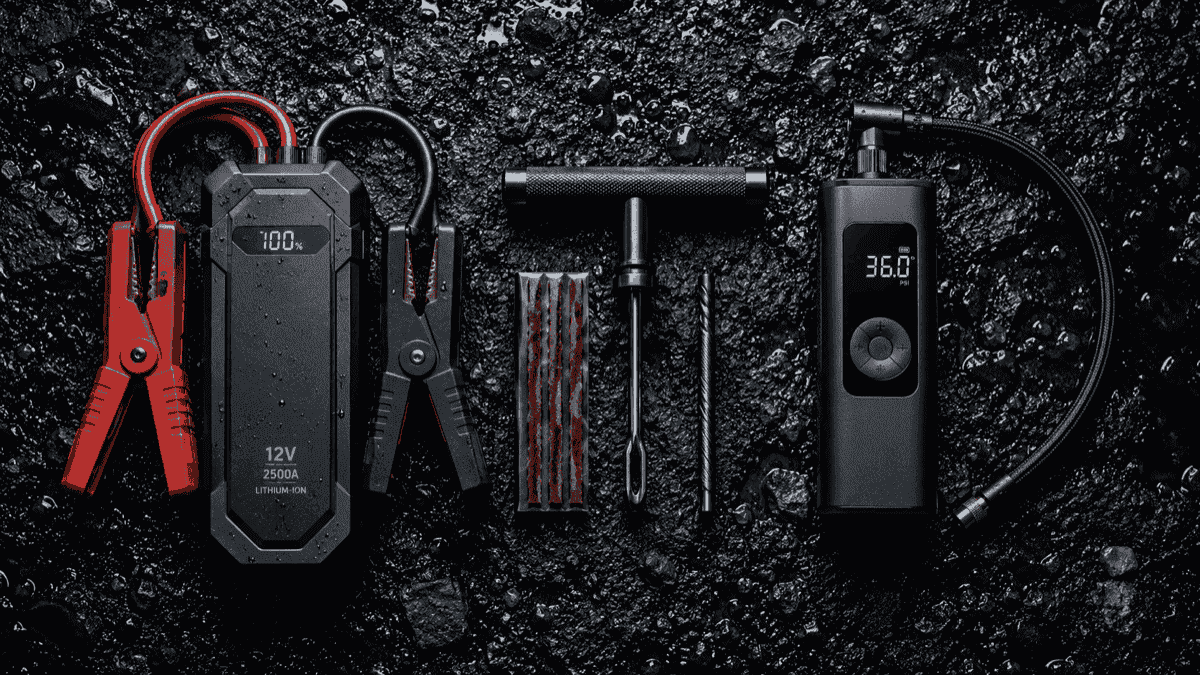
Battery depletion and pneumatic failure make up the roadside failures most drivers can solve without a tow truck. These three tools are non-negotiable because they address the two physical systems that most often immobilize a car: 12V starting capacity and tire pressure containment.
Why These Three Tools Matter
A stranded car is usually not stranded because the vehicle is mechanically destroyed. It is stranded because one recoverable support system has dropped below its operating threshold: battery voltage, tire pressure, or tire casing integrity.
Waiting for emergency roadside assistance solves the problem eventually, but it gives away control over time, location, weather exposure, and traffic risk. A driver with the correct tools can often stabilize the vehicle in minutes, move it out of danger, and decide whether the next stop is home, a tire shop, or a workshop.
The Macro Metrics
A resilience protocol cannot rely on factory packaging. Real-world roadside assistance profiles show that 12V battery failure and tire pressure containment loss consistently make up the majority of non-drivetrain immobilization incidents.
| Primary Failure Vector | Incident Share | Root Mechanical Mechanism | Resolution Protocol |
|---|---|---|---|
| 12V Battery Depletion | ~45% | Plate sulfation / voltage sag under 10.5V during crank | High-capacity lithium booster |
| Pneumatic / Tire Failure | ~9% - 13% | Central tread foreign-object penetration / casing seal loss | Vulcanized plug + digital inflator |
| Drivetrain / Mechanical | ~42% (mixed) | Alternator failure, ignition system faults, cooling leaks | Towing infrastructure required |
- Incident Share
- ~45%
- Root Mechanical Mechanism
- Plate sulfation / voltage sag under 10.5V during crank
- Resolution Protocol
- High-capacity lithium booster
- Incident Share
- ~9% - 13%
- Root Mechanical Mechanism
- Central tread foreign-object penetration / casing seal loss
- Resolution Protocol
- Vulcanized plug + digital inflator
- Incident Share
- ~42% (mixed)
- Root Mechanical Mechanism
- Alternator failure, ignition system faults, cooling leaks
- Resolution Protocol
- Towing infrastructure required
Data source baseline: Statistical indicators are drawn from annual roadside intervention reporting compiled by the Allgemeiner Deutscher Automobil-Club (ADAC), which tracks millions of documented real-world breakdown cases, and cross-checked against corresponding American Automobile Association (AAA) service category patterns.
Modern manufacturers have also made the roadside equation worse. Spare tires are frequently deleted to reduce fleet weight, improve cargo packaging, and lower emissions-test mass. That leaves many cars with nothing more than a compressor-and-sealant bottle, which is inadequate for many tread punctures and useless for a flat battery. A resilience kit closes that gap with tools that solve the failure directly instead of waiting for recovery.
High-Capacity Lithium-Ion Jump Starter
A jump starter solves the failure mode where the 12V battery cannot supply enough current to spin the starter motor and stabilize the control modules during crank. Traditional jumper cables depend on a donor vehicle, correct vehicle positioning, clean terminal access, and another driver willing to help. A lithium jump starter puts the current source in your own trunk.
The important specification is not just the peak amp number printed on the case. Peak amps describe a short burst under favorable conditions, while real starting reliability depends on clamp contact area, internal battery condition, cold-weather voltage sag, cable resistance, and the unit’s protection logic. A good lithium pack also protects sensitive vehicle electronics by controlling reverse polarity, short circuits, overload, and voltage spikes during connection.

Technical Efficacy
- Independent cranking currentA high-capacity pack delivers starter current without a donor car, which matters when the battery dies in a parking structure, remote turnout, or home driveway.
- ECU protection logicReverse-polarity detection, spark suppression, short-circuit protection, and controlled output reduce user-error risk around modern control modules.
- Voltage stabilization marginBetter units maintain enough output under load to crank the starter while vehicle electronics stay awake and synchronized.

Operating Realities
 Cold-weather deratingLithium chemistry loses output efficiency in low temperatures, so a pack that works easily in summer may need a larger capacity margin in winter.
- Storage disciplineA lithium booster is not a permanent object. It must be checked, recharged, and kept away from prolonged extreme cabin heat.
- Not a charging-system repairIf the alternator, battery terminals, parasitic drain, or battery itself is failing, the pack only gets the car moving long enough to diagnose the real fault.
Heavy-Duty Vulcanized Tire Plug Kit
A plug kit solves the most common repairable tire failure: a nail or screw through the central tread area of a tubeless tire. The physical objective is simple but demanding. The repair material must occupy the puncture channel, compress against the tire rubber, resist extrusion under pressure, and hold long enough to reach a safe inspection point.
Factory liquid sealant is convenient, but it is mechanically crude. Sealant can coat the inside of the tire, contaminate the wheel cavity, complicate professional repair, and interfere with tire pressure monitoring sensor service. A proper plug kit is more controlled. Sticky butyl rubber repair strings are forced into the puncture channel with a reamer and insertion tool, then compressed by internal tire pressure against the surrounding tread structure.
Tool quality matters because puncture channels are not polite. Steel belts, stiff tread blocks, truck tires, and cold rubber require leverage. High-leverage T-handles give the driver better control than small plastic handles that flex, crack, or force the wrist into a poor angle.
Technical Efficacy
- Butyl rubber sealing massVulcanized plug material compresses into the puncture path and creates a dense mechanical seal against the tread rubber.
- Steel-belt penetration controlA rigid reamer and insertion probe can clean and size the channel without folding under belt resistance.
- T-handle leverageBroad handles increase torque and push force, which matters when repairing SUV, truck, trailer, or off-road tire tread.
Operating Realities
- Tread-zone boundaryPlug kits are only for small punctures in the main tread area. Sidewall, shoulder, bead, blowout, and exposed-cord damage are structural failures.
- Inflation still requiredA plug seals the leak; it does not restore pressure. The kit must be paired with an inflator and pressure gauge.
- Temporary repair statusAn exterior plug can get you moving, but a tire shop should inspect the casing and apply an internal patch-plug when permanent repair is appropriate.
Cordless High-Output Digital Tire Inflator
A tire inflator solves the pressure side of the pneumatic failure. Even after a puncture is sealed, the tire remains unsafe until it is brought back to a usable pressure and verified. A slow leak also becomes manageable if the driver can add air before the tire overheats, deforms, or damages the sidewall.
The best inflator is not simply the smallest compressor with a digital screen. Output volume, pressure accuracy, hose temperature, duty cycle, and cutoff logic determine whether it can inflate a real car tire without overheating. Dual-cylinder or high-volume pump designs move air faster than tiny emergency units, while digital auto-shutoff reduces overinflation risk by stopping at a target pressure.
Thermal behavior is the constraint. Compressing air creates heat. Long inflation sessions on large tires can push small pumps into thermal shutdown, so the tool must be used within its duty cycle instead of treated like workshop air.
Technical Efficacy
- Target-pressure auto-shutoffA digital preset lets the driver inflate to a defined PSI value without constantly stopping to check the gauge.
- Slow-leak managementThe inflator can restore pressure after a plug repair or keep a leaking tire safe enough to reach a repair facility.
- High-volume pump advantageStronger pump assemblies reduce inflation time, which lowers roadside exposure and makes the tool usable on larger tires.
Operating Realities
- Duty-cycle heat limitsCompact compressors need rest periods. Continuous operation beyond the rated duty cycle can trigger thermal cutoff or shorten motor life.
- Battery capacity ceilingCordless inflators trade cable convenience for runtime limits, especially with SUV tires or multiple low tires.
- Gauge verification still mattersBuilt-in digital gauges are useful, but a separate pressure gauge is still the best way to verify final pressure after the tire cools.
Bottom Line
The minimum roadside resilience ecosystem is not a bag of random accessories. It is a controlled recovery stack.
The jump starter restores electrical cranking capability. The plug kit restores tire casing pressure retention. The inflator restores usable pneumatic pressure. Together, they cover the two failure categories that most often convert a working car into an immobile one without requiring drivetrain repair, advanced diagnostics, or a tow truck as the first move.